
The marking gauge is used to mark lines parallel to the sides, edges, or ends of a board.
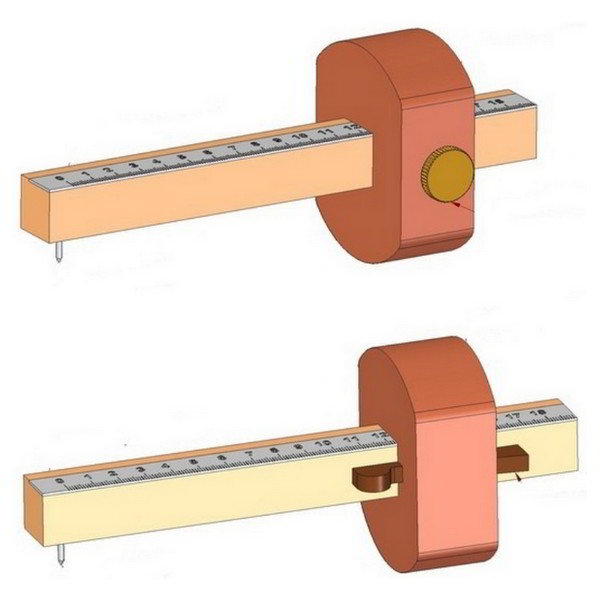
The required distance is set by measuring from the point of marking spur to the head, or by taking a reading directly from the graduated scale on the beam. It consists of a head or stock and a bar or beam provided with a spur. The beam is fitted to the through mortise and is secured at any point in its length by the thumb nut or a wedge.
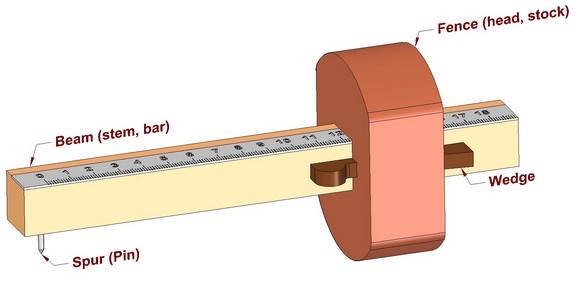
Swedish marking gauge
Marking gauge with rectangular long stock and rectangular beam. The beam is held in place by wedges.
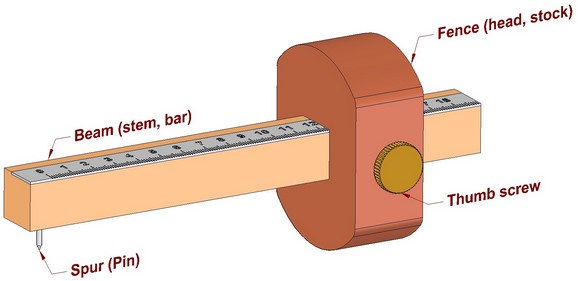
English marking gauge
English marking gauge differs from the Swedish one in having a thumb screw on one side of the stock, which works against the beam and holds it in position.
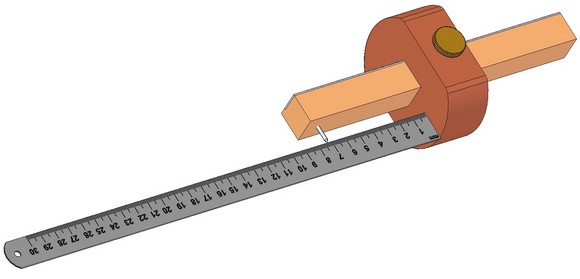
By clamping the bar so as to bring the spur a given distance from the stock, a like distance may be gauged from any straight edge. The beam is usually graduated in millimeters or inches. The graduations on the beam are seldom reliable. It is safer to set the gauge with the rule by measuring the distance from the spur to the gauge head. This is done by holding the gauge bottom side up in the left hand. With the right place the end of the rule against the head. After the thumb screw has been tightened, apply the rule again to make sure of the correctness of the setting.
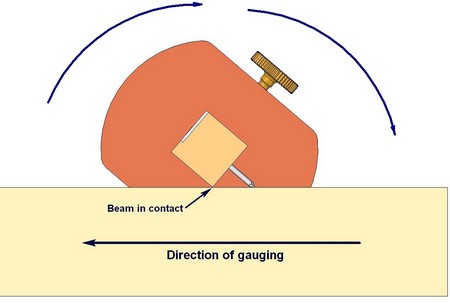
To gauge the line, take the marking gauge in the right hand, three fingers grasping the beam, the first finger encircling the head, if the work is narrow, and the thumb back, or nearly back, of the spur. The head should be kept against one or the other of the faces. Begin at the end of the piece which is towards you, hold the block firmly against the piece, roll the beam forward until the spur barely touches the surface, and make a very light line. Avoid deep lines; they are inaccurate even if straight and always cause trouble in the making unless the grain of the wood is perfectly straight.
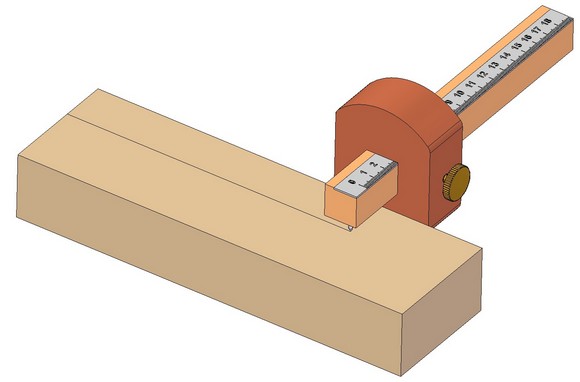
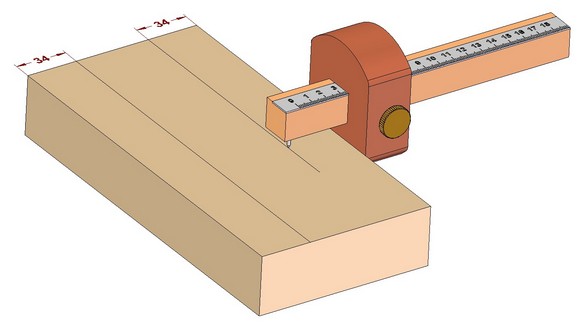
Marking gage are excellent for repeating dimension lines. You can repeat marking as often as you wish.
Roll the marking gage so the spur just touches the surface for a light gauge line.
The spur of a marking gauge may be sharpened to a conical point or to a knife edge.
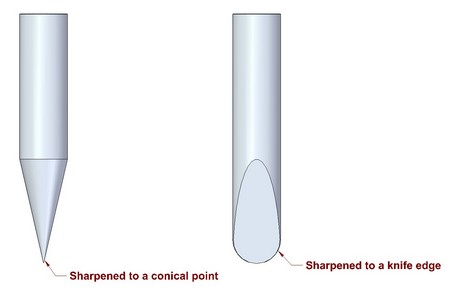
The spur should be sharp to do good work. If sharpening is necessary, loosen the set screw, remove the spur, and file or grid. If sharpened to a knife edge, the edge of the spur should be set parallel with the head of the gauge. Tighten the setscrew to hold the adjusted pin securely.